> For the complete documentation index, see [llms.txt](https://docs.scrt.network/secret-network-documentation/llms.txt). Markdown versions of documentation pages are available by appending `.md` to page URLs; this page is available as [Markdown](https://docs.scrt.network/secret-network-documentation/secretvm-confidential-virtual-machines/launching-a-secretvm/using-custom-domain-names.md).
# Using Custom Domain Names
How to launch a SecretVM under a custom domain name
When a SecretVM is created, a random fully qualified domain name (FQDN) is created for it. A subdomain of one of the domains that belongs to the Portal, such as `secretvm.com`, is used, so the resulting domain name would look something like this: `tomato-dolphin.secretvm.com`
It is also possible to launch SecretVM with a custom domain name under a domain managed by the develoloper.
Do do that, it is required to specify the domain name in Custom Domain box:
After Launch Your SecretVM is clicked, the machine will be created, but not yet launched.
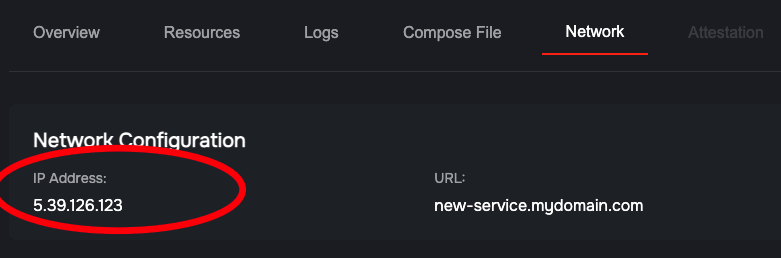
Go to the Network tab to find the IP address that was assigned to the new machine, and then configure your DNS to point the chosen FQDN to that IP.
Once the DNS records are created and sufficiently propagated, launch the SecretVM.
#### CNAME record for ZeroSSL Certificate
After the VM starts, you will need to create an additional DNS record under your domain - this is required by ZeroSSL to validate ownership of the domain before issuing a new DNS certificate.
Go to the Logs tab of the machine, and search for "CNAME Challenge":
Copy the name of the record and the expected value, and create a respective record under your DNS. ZeroSSL script will continue retrying multiple times until it can read the expected record.
Once the script identifies the required DNS record, it will generate the SSL certificate and continue with the startup routine.
---
# Agent Instructions
This documentation is published with GitBook. GitBook is the documentation platform designed so that both humans and AI agents can read, navigate, and reason over technical content effectively. Learn more at gitbook.com.
## Querying This Documentation
If you need additional information that is not directly available in this page, you can query the documentation dynamically by asking a question.
Perform an HTTP GET request on the current page URL with the `ask` query parameter, and the optional `goal` query parameter:
```
GET https://docs.scrt.network/secret-network-documentation/secretvm-confidential-virtual-machines/launching-a-secretvm/using-custom-domain-names.md?ask=&goal=
```
`ask` is the immediate question: it should be specific, self-contained, and written in natural language.
`goal` is optional and describes the broader end goal you are ultimately trying to accomplish on behalf of the user. GitBook uses it to tailor the answer towards what is most useful for that goal.
The response will contain a direct answer to the question and relevant excerpts and sources from the documentation.
Use this mechanism when the answer is not explicitly present in the current page, you need clarification or additional context, or you want to retrieve related documentation sections.